

Turning Iloilo's problem, rice husk and straw, into stronger harvestsPutting biochar carbon back into the soil, not the sky.
The rice husk and straw once burned or left to rot in Iloilo's fields becomes Platinum BioChar — building climate resilience with higher yields, better water retention and less fertiliser, and bringing new income and jobs that lift farming families out of poverty and fight malnutrition.
One project, three ways forward
A bankable climate opportunity
Secured site, contracted feedstock, and a clear path from one line to a 36,000 t/yr platform. Explore the opportunity and the data room.
Invest & Partner →Durable, verified removal
Puro.earth CORC200+ credits with Carbonfuture MRV+ and full chain-of-custody — every batch tracked and third-party verified.
Carbon & MRV →The missing piece of SERBISYO
Aligned with the Province of Iloilo's rice agenda — farmer income, TESDA training and measurable local impact.
Rice Resilience →A climate emergency for Iloilo's rice farmers
El Niño-driven drought, rising temperatures and increasingly erratic rainfall are cutting rice yields across Iloilo and the wider Philippines — while the cost of imported inorganic fertiliser keeps climbing. Farming families bear the brunt, with women and children most exposed to the loss of income and nutrition. Most rice husk is still burned as waste, adding emissions instead of value.
What Platinum BioChar delivers
Biochar tackles every stressor at once — cutting fertiliser dependence, holding water in the soil, lifting yields, and locking carbon away for centuries.
Inorganic fertiliser
Less NPK needed — about US$160/ha saved for farmers.
Soil water retention
Drought resilience; field capacity up 20 to 51% by soil type.
Rice yield
+15% adoption closes ~29% of the gap to the 6 t/ha target.
CORCs removed / year
At full build — 7,200 per unit × six units; each a permanent 200+ yr removal (CORC200+).
Paddy methane
Plus nitrous oxide (N₂O) down ~31% — powerful climate co-benefits.
Silicon (SiO₂)
Rice-husk biochar strengthens crops — disease & lodging resistance.
The scale of Mina at full build
Phase 1 begins with one 6,000 t/yr line and ~20,000 t/yr feedstock sourced within 15 km; the full six-unit build sources rice husk & straw within 25 km. Every credit is a permanent 200+ year removal (CORC200+). Full-build figures are projections.
Rice husk to permanent carbon, in four steps
Harvest husk
Rice-mill residue collected from 35 mills within 15 km.
→Pyrolyse
Continuous rotary-kiln, 450–600°C; syngas recycled for heat.
→Platinum BioChar
Weighed, sampled and certified — the durable carbon product.
→Sequester & enrich
Applied to soil — carbon locked 200+ years, yields lifted.
→The Mina Platinum BioChar production line
A continuous rotary-kiln pyrolysis system — rice husk in, Platinum BioChar out, with syngas recycled for heat and no grid power required.
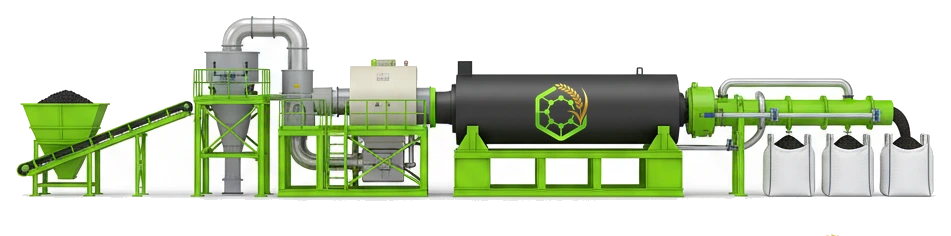
Illustrative rendering of the Mina process line.
The missing piece of Iloilo's rice agenda
Positioned in support of Governor Arthur “Toto” Defensor Jr.'s SERBISYO programme — the Province of Iloilo's drive to reach 6 t/ha, which explicitly calls for private-sector partners. Biochar is the one soil-health & residue-valorisation pathway that also earns verified carbon revenue.
Climate-resilient soil
Nutrient efficiency
Water conservation
The Department of Agriculture's institute pioneered continuous rice-husk carbonisation.
Replicated IRRI and peer-reviewed trials show rice-husk biochar lifting yields and locking carbon in the soil for centuries.
The Mina Biochar Carbon Removal Project
Brgy. Cabalabaguan, Mina · Iloilo 🇵🇭
The case for Mina
- Contracted feedstock — ~20,000 t/yr from 35 mills within 15 km.
- Secured site — 99-year industrial leasehold.
- Credible carbon stack — Puro.earth CORC200+ via Carbonfuture.
- SERBISYO-aligned — the missing piece of Iloilo's rice agenda.
- Clear scale-up — one line → six units, 36,000 t/yr in three years.
- Farmer income at scale — expansion adds rice straw, paying farmers for residue and lifting rural livelihoods.
Carbon you can trust — every batch tracked
The 6-step biochar lifecycle:
Built with farmers, mills and the community
“[Placeholder — a rice farmer on higher yields and a fair price for husk once burned as waste.]”
“[Placeholder — a rice-mill partner on turning residue into revenue and cleaner air.]”
“[Placeholder — a TESDA-trained worker on new local jobs and skills.]”
Together, we carry the load. In our tradition, bayanihan is the whole village coming together to lift a neighbour — when a family moves their home, everyone carries it together. That is the spirit of the programme: farmers, families and partners lifting one another — from Mina, for the Philippines.
“Bayanihan” — an original oil painting; a wedding gift from Maribeth de Montaigne to her husband David de Montaigne on their wedding day, 35 years ago. · The programme is delivered with our independent non-profit partner, School Aid MTÜ.

Lifting farming families — women and children first
Our independent non-profit partner, School Aid MTÜ, runs the Bayanihan community programme — farmer training, school and child support, and women's empowerment across Iloilo — the socio-economic heart of the SERBISYO rice agenda, behind an ironclad charity/company wall.
Explore the impact →Farmer households
Year-1 target
Children supported
Year-1 target
Participation
Embedded
Anti-malnutrition
Benteng Bigas aligned
Latest from Biomass Asia
Why CORC200+ permanence matters to buyers
How durability class and chain-of-custody underpin credible removal.
Biochar and the road to 6 t/ha
How soil-health gains support Iloilo's SERBISYO agenda.
From one line to six units
Scaling to a 36,000 t/yr platform within three years.
From a rice crisis to permanent carbon — and farmer prosperity.
Invest, buy verified removal, or partner with us for Iloilo's rice farmers, our community and the climate. Get the latest — no spam.